Retail · UK
Red Label Outlet: social content without the bottle hunt
Red Label Outlet's social content now starts from a product pick and ends with a finished brief for an image, a video and a caption, after a quick approval in Telegram. It replaces a manual cycle of fetching, searching, designing and converting. The project is live and still developed on a regular basis.
Snapshot
| Field | Detail |
|---|---|
| Client | Red Label Outlet (RLO), UK luxury fragrance e-commerce on Shopify |
| Brief | Keep an active social media presence by turning catalogue products into ready-to-post content, with a person approving each one |
| Status | Live, and developed continuously |
| Built within | 2 to 4 hours a week |
| Our role | Sole engineer and decision-maker |
Result at a glance
One item used to take at least 45 minutes by hand, from research to posting. With the pipeline it takes about 4 minutes of hands-on time per item: about 2 minutes to render (about 30 seconds of it approving in Telegram) and about 2 minutes to post.
| Measure | Result |
|---|---|
| Time per item, before (our estimate) | At least 45 minutes, from research to posting |
| Time per item, now (our estimate) | About 4 minutes of hands-on time per item: about 2 minutes to render (about 30 seconds of it approving in Telegram) and about 2 minutes to post. |
| Catalogue covered | 2,289 products |
| Visual variety | 30 distinct settings, so consecutive posts look different |
| Content made for | Instagram, Facebook, Threads, Pinterest and TikTok |
The problem
RLO sells fragrance online from a catalogue of 2,289 products, and its social channels need a steady supply of on-brand content. Making each post by hand meant the same cycle every time:
Fetching the bottle and its details from the retailer's website.
Searching Google for relevant bottle images and references.
Designing the post in Canva.
Converting the design into a video.
Done for every item, that cycle took at least 45 minutes and did not scale across a catalogue that size.
What changed
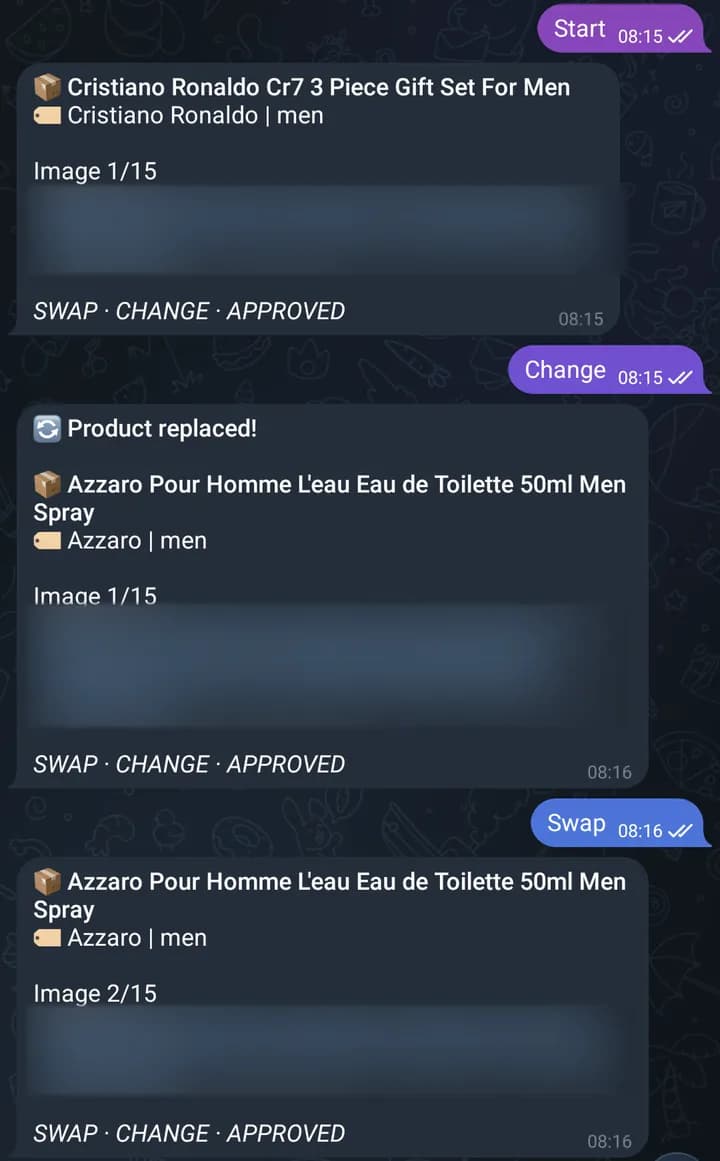
Today the work starts with a product pick and ends with everything needed to post: an image brief, a video brief and a caption. A person approves each product in Telegram, renders the visuals and posts them to Instagram, Facebook, Threads, Pinterest and TikTok.
| Step | Before | Now |
|---|---|---|
| Choosing a product | Fetched by hand from the retailer's website | Picked from the live catalogue and approved in Telegram |
| Finding references | Searched on Google | Built from the real product photo and its listed notes |
| Designing the post | Built in Canva | Image brief generated automatically |
| Making the video | Converted by hand | Video brief generated automatically |

Live on five platforms

Instagram

Facebook
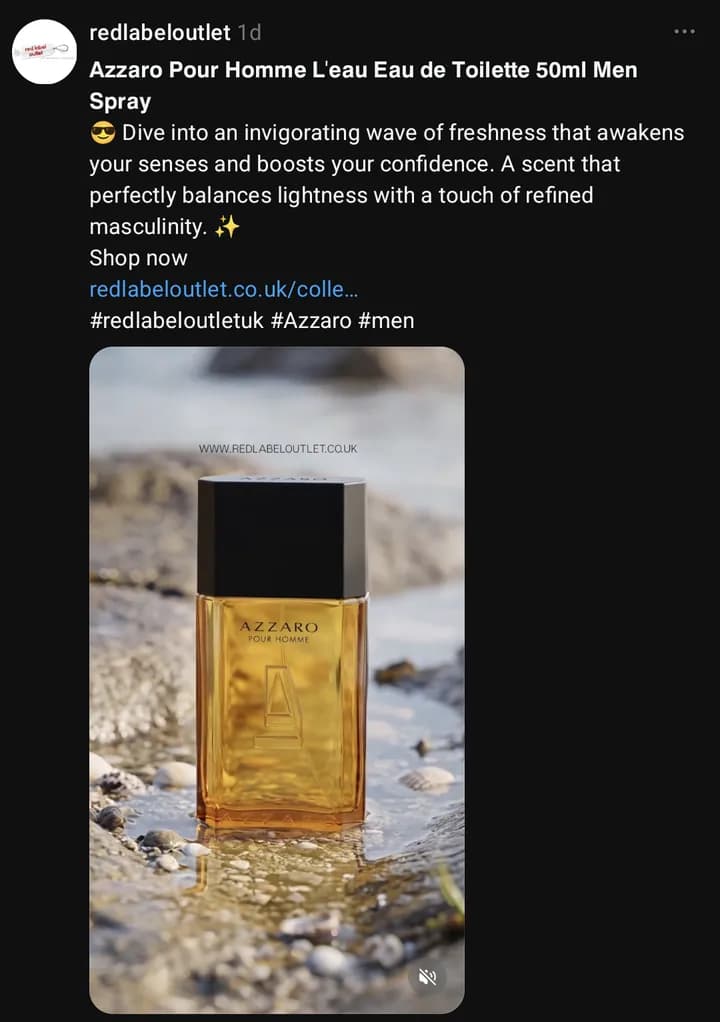
Threads

TikTok

Pinterest
How quality is protected
The pipeline is built so that a bad result is caught before it is posted.
A person approves each product. Nothing is made until it is approved in Telegram.
Picks are checked against the real catalogue. A product that is not in the live catalogue is rejected and an alert is raised.
A real product anchor. Images start from the real product photo, so the bottle on screen is the real bottle.
Alerts on failure. When something breaks, an alert arrives instead of a silent gap.
Safe changes on a live client. Backups first, one change at a time, tested on a copy, with a way back.
Decisions and trade-offs
| Decision | Why | Trade-off |
|---|---|---|
| A person approves each product | Control over what gets made | Someone has to respond to every run |
| Rendering and posting by hand | Cost and control | Manual time on every post |
| Changed the video style after testing | The original concept could not be made reliable, however it was prompted | Gave up the original concept for a simpler, more natural style |
| One change at a time, tested on a copy | Protects a live client | Slower releases |
Always in development
This is a continuing project, not a one-off build. It is improved on a regular basis, and recent work has changed it in these ways:
Wider coverage. The pipeline now reads the whole catalogue of 2,289 products, up from an assumed 750.
More variety. Posts no longer share the same background, and consecutive posts look different.
A cleaner queue. Duplicates and dead product links were removed, so nothing broken reaches an approval.
Better checks. Failures now raise alerts instead of passing silently.
A video style that works. The original concept was replaced after testing showed it could not be made reliable.
What we learned
Measure, don't eyeball. Measurements settled arguments that eyeballing had stretched across whole sessions.
Know when the tool is the ceiling. After repeated identical failures we changed the concept instead of testing one more prompt.
Silent failures are the real risk. The worst problems were the ones that passed without an error and ran for days before anyone saw them.
Time shapes the build. Manual rendering and small test runs follow from 2 to 4 hours a week.
Results
The pipeline is live, in regular use and still being developed.
Verified:
- Live and in regular use, with every product family validated through live runs.
- Coverage of the full catalogue of 2,289 products.
- 152 posts published on each of the five platforms, as of 12 November 2026